
 Zero Knowledge Proofs
Zero Knowledge Proofs (ZKPs)
Zero Knowledge Proofs (ZKPs) are cryptographic protocols where a prover convinces a verifier that a statement is true without revealing any additional information beyond the validity of the statement itself.

The Core Principles of Zero Knowledge Proofs
Formally, ZKPs satisfy three properties: completeness (true statements can be proven), soundness (false statements cannot be proven), and zero-knowledge (no information beyond validity is revealed). This balance of privacy and verifiability is vital for secure AI operations, particularly in scenarios where sensitive data must remain confidential while ensuring computational integrity.
Zero Knowledge Wrappers
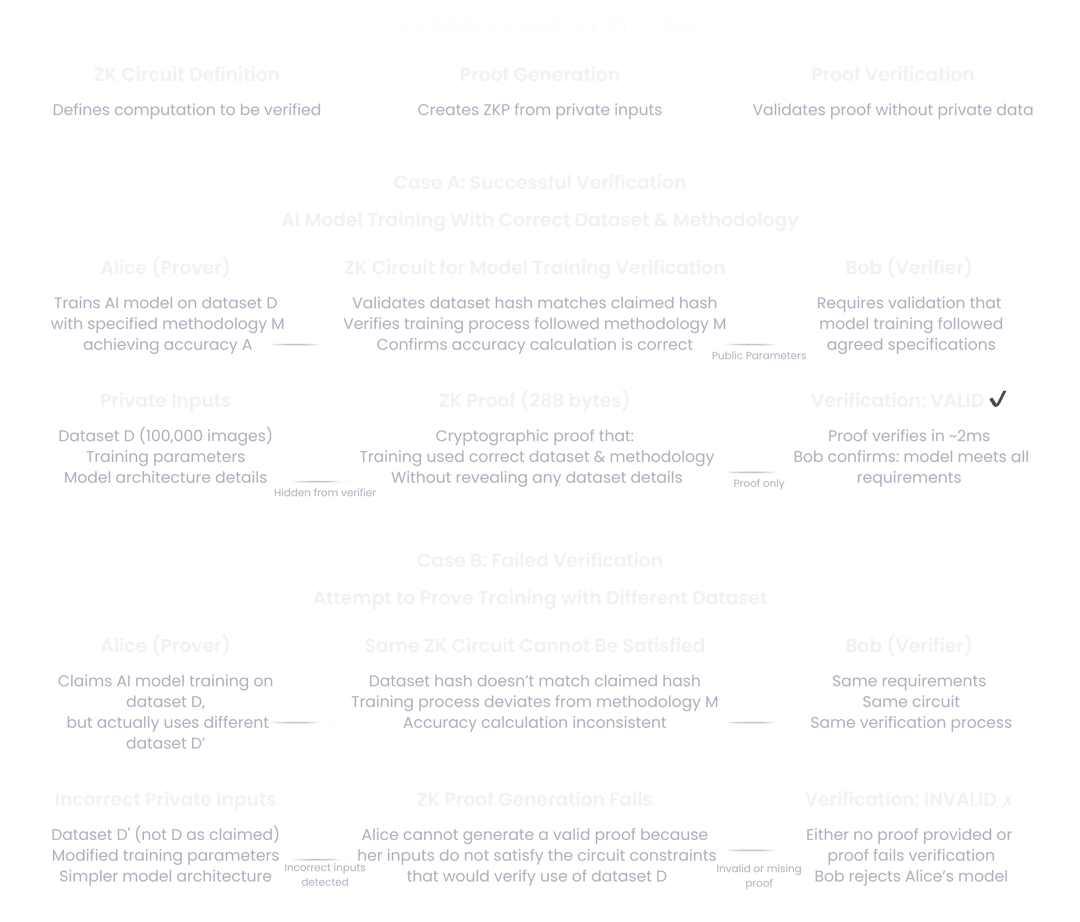
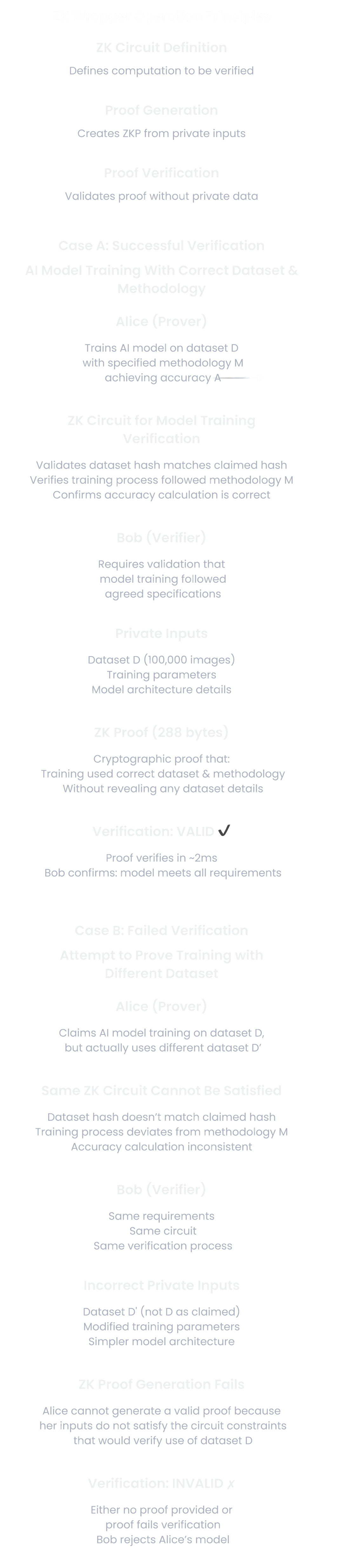
ZK Wrappers enforce honest computation without revealing sensitive data
Collaborative AI Trust Without Data Exposure
For example, Alice wants to prove to Bob she trained an AI model on a specific dataset without revealing it. Using ZKPs, she generates a proof of the training's correctness, which Bob verifies without seeing the data. This ensures that proprietary information remains protected while still allowing for trust in the model's validity. Such a mechanism is critical in collaborative AI environments where multiple parties need assurance without compromising their data.

Practical Implementations: zk-SNARKs and zk-STARKs
Techniques like zk-SNARKs and zk-STARKs ensure efficient, private computation validation in the ZKP ecosystem through both EVM pallet and native Substrate verification infrastructure, leveraging advanced cryptographic methods to achieve succinct and scalable proofs. These methods reduce the computational overhead, making ZKPs practical for real-world blockchain and AI applications.
The Proof Behind Champions
Those who compete at the edge of human precision now back the technology that defines digital truth.